Frozen pipe, no water at the tap
How to thaw frozen pipes: find the main shutoff, open the faucet, then warm the pipe gently from the faucet back with a hair dryer, heating pad or warm cloths, never a flame.
Thawing a frozen pipe
- Main shutoffKNOW IT, BE READY
- Wet spot, bulge or crack on the pipeMAIN CLOSED, GO TO §E-3
- Faucet on that lineOPEN
- Cabinet doors under the sinkOPEN
- Torch or any open flameNEVER
- Boiling waterNEVER
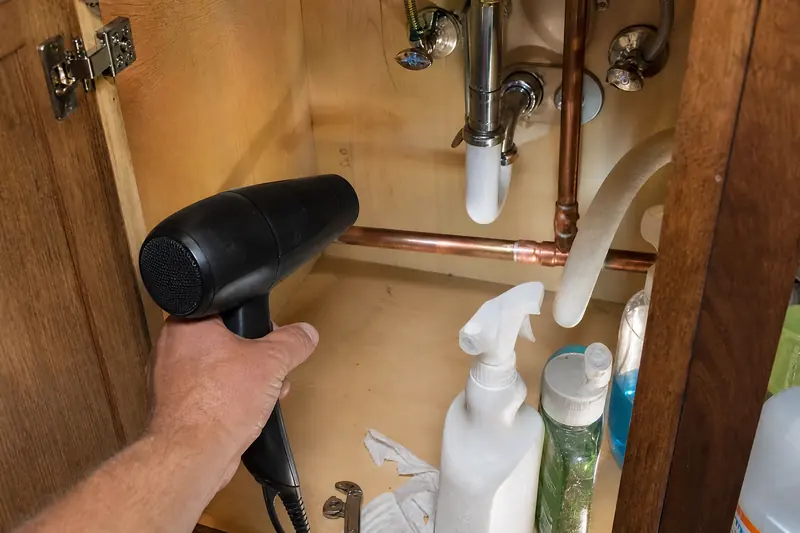
- Hair dryer, heating pad, warm clothsSTART AT THE FAUCET
- Cords and dryerKEEP AWAY FROM WATER
- Flow back at full pressureCHECK THE LINE FOR LEAKS
- Can't find or reach the frozen spotCALL A PLUMBER
- Use this when
- A tap gives little or no water in freezing weather and other taps still work.
- Done when
- Full pressure is back at the tap and no pipe is leaking.
- Who
- You, then a licensed plumber
Written for this manual, last checked against sources November 4, 2026. Who wrote it
E-4.1 Which comes first, the faucet or the main?
The sources differ. The National Weather Service says to open the faucet first. Utah State University Extension says to shut the main first, then open the faucet. The reason is that a frozen pipe may already have split, and the leak only shows when it thaws.
So stand ready either way. Know where the main shutoff is, §1-2, before you warm anything. If you see any sign of a split, or you can't watch the pipe while it thaws, close the main first. Open the faucet in every case, to relieve the line.
E-4.2 Warm it slowly
Start at the faucet and work back toward the frozen part, warming gradually. Good tools are a heating pad, an electric hair dryer or warm cloths. Don't use a wet cloth and an electric tool together, and skip boiling water. Open cabinet doors under the sink so house heat can reach the pipe, if the house has power.
Keep going until pressure returns, or call a plumber. If you closed the main, open it slowly at the end and watch the thawed length for drips.
E-4.3 Frozen lines in a crawl space
This is where to stop. No source this manual could open gives crawl-space thawing steps, so it doesn't offer any. Do not put a space heater in a crawl space. Call a plumber.
The same goes for a line you can't see at all, or one on a well or cistern outside the house. If the taps are dead everywhere, also go through §E-5, because the freeze may not be the cause.
E-4.4 Once it runs again
Leave that faucet at a drip while the cold lasts, as IBHS advises for extreme cold. Keep the thermostat at 55°F or above. A pipe that froze once is likely to freeze again, so read §7-1 and §7-2 when the emergency is over.
Moving picture for §E-4
How to deal with frozen pipes, posted by United Utilities. From a UK water company, 2012. A stop tap is the main shutoff, and lagging means insulating. Keep a hair dryer away from standing water. The still picture sits on this site; nothing comes from YouTube until you press Play.
Where this comes from
- National Weather Service, after the cold: open the faucet, tools, no open flame, continue or call.
- Utah State University Extension, frozen pipes: main first, start at the faucet, warm gradually, no flame, no boiling water.
- Illinois Extension, water pipes: never a flame or torch.
- CDC, staying safe after a winter storm: no torch, warm air from a hair dryer.
- IBHS, after a winter event: open cabinet doors.
- IBHS, before a winter event: 55°F minimum, drip in extreme cold.
Sources checked November 4, 2026.