Contents Chapter 9. Swamp coolers
Starting a swamp cooler in spring
Swamp cooler start up is a power-off job: cut the power at the breaker or switch before the ladder goes up, do the roof work, come back down, and only then restore power.
- Use this when
- Spring has come, hard freezes look over at your place, and the cooler has been shut down since fall.
- Done when
- Pads are good, water holds at the right level, the unit runs from the ground, and no leak shows at the base or ceiling.
- Who
- You, if you are steady on a ladder; otherwise someone you hire; a licensed electrician for any damaged wiring
Written for this manual, last checked against sources November 4, 2026. Who wrote it
Swamp cooler sources are thin. This section leans on DOE and on the University of Arizona Extension, so treat what it says as Arizona advice. Steps marked as ordinary practice come from neither.
Before the ladder goes up
- Cooler breaker or switchOFF
- Wall control, triedNOTHING RUNS
- Wall control, afterwardSET TO OFF
- Note at the breaker panel"COOLER WORK, LEAVE OFF"
- Second personON THE GROUND
- RoofDRY, NO ICE OR HIGH WIND
9-1.1 What order keeps the power off?
Power goes off first and comes back last, with everything between done dead. Use the breaker if you can find it, since a wall control saying off may not cut power to the whole unit. These power steps are this manual's own rule, not something taken from those sources.
- Do the drill above. The power stays off through step 8.
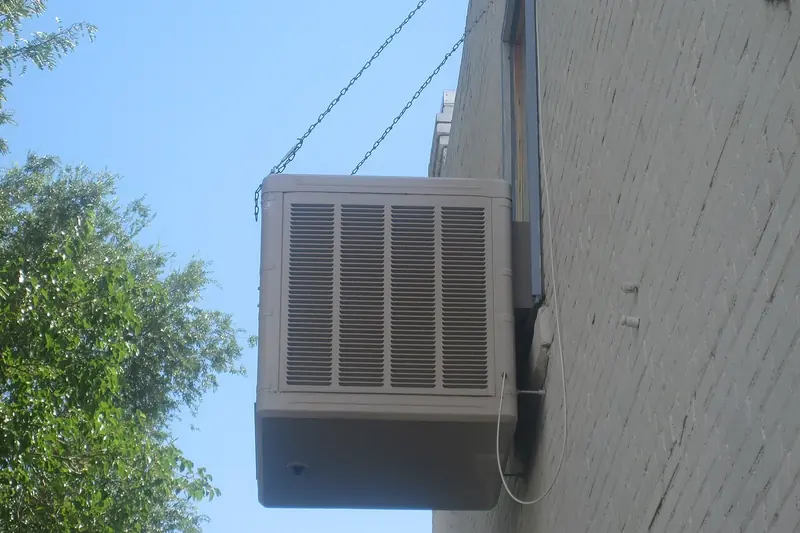
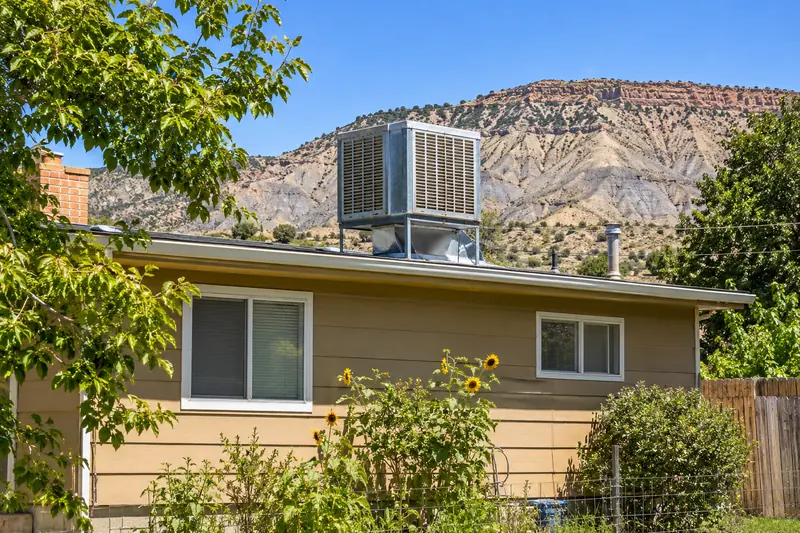
- Go up and remove the side panels. Set them where wind can't take them.
- Look at the pads. The Arizona page says to replace pads with heavy mineral buildup.
- Check the tray for cracks and rust and for last year's scale. As ordinary practice, also look over the belt, the pump and the wiring. If a wire or plug looks damaged, stop there and leave the power off for an electrician.
- Reconnect the water line if it was taken off in fall (§9-2), and have your helper open its feed valve slowly.
- Watch the tray fill. Water should stand about an inch below the top and below the overflow. Adjust the float if it doesn't stop there.
- Set the bleed-off to drain no more than necessary. Refit the panels.
- Come down and put the ladder away.
- Remove the note and restore power from the ground. Leave a window or two partly open, since DOE describes the warmer air being pushed out through windows, and run the cooler from the wall control.
9-1.2 How much water will it use?
More than most people guess. The same Arizona Extension page gives 50 to 200 gallons a day. That's an Arizona figure and yours may differ, but on a hauled-water or cistern house it belongs in your delivery plan (§3-2).
The Arizona page also says that waiting to start the fan until 85°F cuts water use by 50 percent. It is an easy habit to try, and you can watch your own bill or tank level to see what it does for you.
Check for leaks after it has run. Start with ceiling stains from indoors. Clifton Water District's self-audit lists evaporative coolers: puddles and stains at the base and on the roof, plus the supply line, float valve and reservoir. Anything on the roof means power off first, using the drill. A sticking float runs continuously, which wastes water and can show up on a meter test, §6-2.
9-1.3 When is a swamp cooler the right tool?
It works where the air is hot and dry. DOE says these coolers use evaporated water to cool outdoor air, and they work well where air is hot and humidity is low. This manual couldn't confirm a humidity cut-off number, so go by how the house feels. Cooling need also varies a lot across the Slope.
| Station | Cooling degree days |
|---|---|
| Grand Junction Walker Field | 1,233 |
| Delta 3E | 833 |
| Montrose #2 | 793 |
| Paonia 1SW | 683 |
| Cedaredge 3E | 557 |
Those are weather stations, not towns. A higher number means more warm weather to cool against. §1-3 has the rest of the picture.
Also asked
When in spring should I start the cooler?
No source here gives a date. As ordinary practice, wait until hard freezes look over at your place, because a line refilled too early can freeze. Go by your own place, and remember you can hold off on the fan until 85°F anyway.
Why does water keep running into the cooler?
A sticking float is the first suspect. Turn the power off, follow the drill, and check that the float moves freely and stops the water below the overflow. If it still runs, close the feed valve and get help.
How often do pads need replacing?
The Arizona page gives no calendar, only the condition: heavy mineral buildup means replace. Harder water may mean sooner, and §4-2 tells you how hard yours is.
Why cut the breaker if the cooler is already off at the wall?
Because a wall control may not cut power to everything in the unit. Hands near a pump, a fan and a belt in a wet tray are the wrong place to find that out. That's why the drill has you try the control before anyone goes up.
Where this comes from
- University of Arizona Extension, Cochise County Water Wise, water-saving tips (Arizona): gallons a day, 85°F, water level, float, bleed-off, pads.
- DOE, Energy Saver guide, 2022: how evaporative cooling works, where it works, air out through windows.
- NIOSH, ladder safety, reviewed March 1, 2024: ladder deaths, homeowner training, ladder angle.
- Clifton Water District, indoor leak self-audit: cooler leak checks.
- NOAA NCEI, 1991-2020 normals, station data: cooling degree days by station.
Sources checked November 4, 2026.