The pump and the pressure tank
A well pressure tank holds pressurized water so the pump starts less often, while a pressure switch starts and stops the pump, and your part is reading the gauge, not adjusting either one.
- Use this when
- The pump cycles oddly, pressure seems wrong, or you want to understand the system before something fails.
- Done when
- You can find the gauge, know its normal range on your system, and have the installer's name on your house card.
- Who
- You read the gauge, then a licensed pump installer
Written for this manual, last checked against sources November 4, 2026. Who wrote it
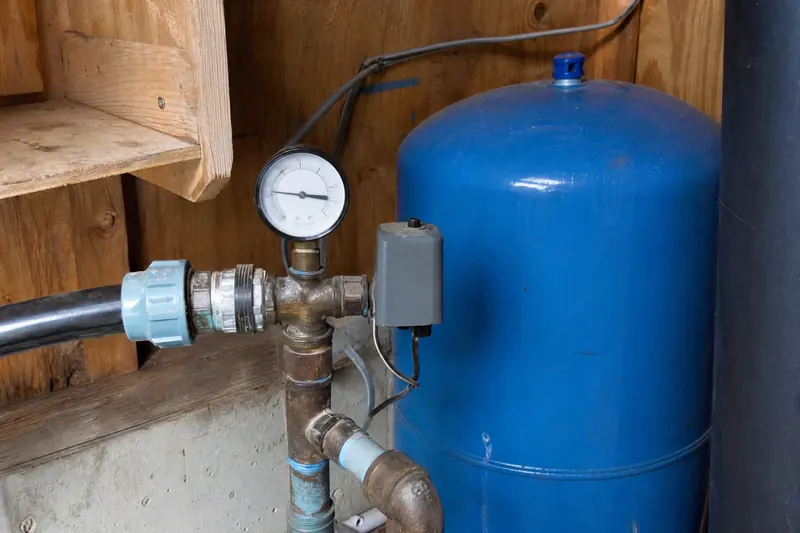
2-2.1 How do the pump, switch and tank work together?
Fig. 2-2 How a well pressure system runs, in order
- Tap opensWater leaves the tank and pressure falls.
- Pressure switchStarts the pump at its set point, often 30 or 40 psi.
- Pump runsRefills the tank until pressure is about 20 psi higher, then the switch stops it.
- Pressure tankHolds pressurized water, so the pump starts less often.
Nebraska Extension. Your installer knows your own setting.
The switch runs the pump and the tank saves it from running constantly. Nebraska Extension describes the switch starting the pump when pressure falls to a set point, "often 30 or 40" psi, and stopping it about 20 psi higher. The tank stores pressurized water between those two points, so a glass of water doesn't start the pump every time.
Inside many tanks a cushion of air, called the pre-charge, does the pushing. Nebraska Extension puts it at 2 psi below pump start with the tank fully drained, so a 30 psi start means 28 psi. It treats that check as a licensed professional's job and notes that some makers void the warranty if anyone else removes the valve cap.
Amtrol's Well-X1 manual gives a factory setting of 40 psi cut-in and 60 psi cut-out for that one model. It also says a narrow differential can make the pump cycle rapidly and damage it. Your system may run differently, so ask the installer what yours should read and write it on your house card (§1-1).
2-2.2 What can the gauge tell you?
It can tell you whether the system holds pressure and how the pump is behaving. Watch it through a normal cycle a few times while everything is working, so you know what ordinary looks like on your house. Then the signs below mean something.
| What you see | What it may mean | Who takes it |
|---|---|---|
| Pump runs a few seconds and shuts off, again and again | Likely too little air in the tank | Licensed installer |
| Pump runs continuously | A stuck check valve or a broken line | Licensed installer |
| Pressure falls within about a week of a tank adjustment | The tank may need replacing | Licensed installer |
| Water remains when the installer fully drains the tank | The tank may need replacing | Licensed installer |
| Gauge stays steady with water shut to the house | Check valves and lines are likely sound | You, no action |
| Gauge falls with water shut to the house | A line leak or check valve problem | Licensed installer |
These readings come from Nebraska Extension. No water at all is a different problem, with its own checks in §E-5.
2-2.3 Does your system hold pressure?
A short test answers it, and you touch nothing but the house valve. Nebraska Extension gives the logic and no set time, so give it long enough to see a clear result and repeat it if you are unsure. The house valve is the one you found in §1-2, and the table above reads the result.
Gauge check
- PumpFINISHED ITS CYCLE
- Gauge readingWRITE IT DOWN
- House valveCLOSED
- Water use in the houseNONE
- Gauge after waitingSTEADY OR FALLING
- House valveOPEN AGAIN
- Switch and air valveNOT TOUCHED
2-2.4 Who may work on a well pump?
Colorado's law treats paid work and work on your own well differently, and it isn't an open invitation. As published in Colorado's statutes, a pump installation contractor is licensed to install, remove, modify or repair pumping equipment for compensation. A separate section exempts "private pump installers" from license requirements, though they must still meet minimum construction standards and board rules.
The definition is narrow. It means an entity using equipment it owns to install pumping equipment on a well entirely for its own use on land it owns. Pumping equipment there includes the pump, seals and adapters, and waterlines up to the pressure tank. Another section says only a licensed contractor may install a cistern between wellhead and pressure tank. This manual doesn't tell owners to do this work, so take any question about your own case to the Division of Water Resources or a licensed installer.
Moving picture for §2-2
How Does My Private Well Pressure Tank Work?, posted by PrivateWellClass. Its pressure ranges are general. Don't change the switch settings or wiring yourself. The end card promotes a free university class. The still picture sits on this site; nothing comes from YouTube until you press Play.
Linked from this manual
- Well tanks. Replacement pressure tanks. Which size and model fits your system is the installer's call. This manual’s team is connected with PlumbingSupplyAndMore.
Also asked
Can I check the air in my pressure tank myself?
This manual says no. Nebraska Extension explains the 2 psi rule but frames it as a professional's job, and Amtrol limits checking and re-charging to licensed professionals because of its rupture warning.
Is a pump that cycles quickly an emergency?
It isn't a fire, but don't leave it. Amtrol says rapid cycling can damage the pump, and Nebraska Extension links very short runs to too little air in the tank, so book the installer soon.
What should my gauge read?
It depends on your switch setting. Nebraska Extension says starts are often 30 or 40 psi with a stop about 20 psi higher, and only your installer can tell you what yours was set to.
Why would low water show up after the pump is fine?
Nebraska Extension notes low water may mean the pump is set too high in the well. That diagnosis takes an installer and the well's records.
Where this comes from
- Nebraska Extension G2153, private well pressure systems: switch set points, pre-charge concept, warning signs, gauge test, switch warning, drive caution.
- Amtrol Well-X1 installation manual: one model's factory settings, rapid cycling, rupture warning.
- C.R.S. 37-91-102, definitions: contractor, private pump installer and pumping equipment (published copy of the statute).
- C.R.S. 37-91-106, exemptions: private pump installers (published copy of the statute).
- C.R.S. 37-91-109, construction and licensing: licensed contractor rule for cisterns before the pressure tank (published copy of the statute).
Sources checked November 4, 2026.