Contents Chapter 6. Ground and pipes
Swelling soil and your pipes
Expansive soil under a Colorado foundation grows when wet and can move what is attached to it, so keep water back from the house and let pipes through walls and slabs flex.
- Use this when
- You are planting, regrading or running pipe near the foundation, or the house seems to have shifted.
- Done when
- Water drains away on every side, planting sits back from the walls, and any pipe question has gone to a plumber.
- Who
- You, then a licensed plumber and a soil engineer
Written for this manual, last checked against sources November 4, 2026. Who wrote it
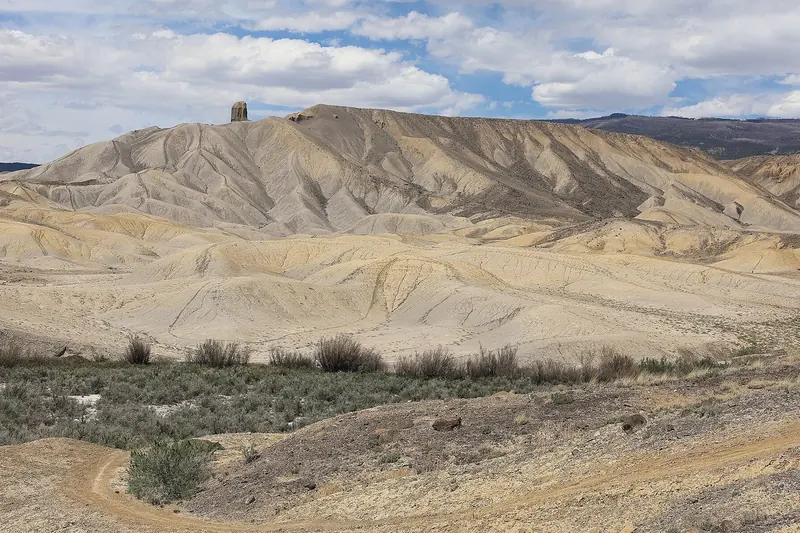
6-1.1 What does swelling soil do on the Slope?
It takes on water, gets bigger, and pushes on whatever sits in it. The Colorado Geological Survey treats a volume increase of 3% or more as potentially damaging, says a soil may expand 10% or more when wet, and lists pipelines and sewer lines among the things it can disrupt.
The state survey's 1978 guide names the Mancos and Lewis shales as the main swelling formations on the Western Slope, and places Grand Junction, Montrose, Delta and many smaller towns on them. That tells you to take the question seriously. It doesn't tell you what is under your lot. The survey says only a soil engineer or engineering geologist should identify these soils.
Requirements can differ by subdivision. Mesa County keeps a list of foundation requirements by subdivision, dated 07/29/2022 and called "a working document". If you are in another county, ask its building office (§10-1).
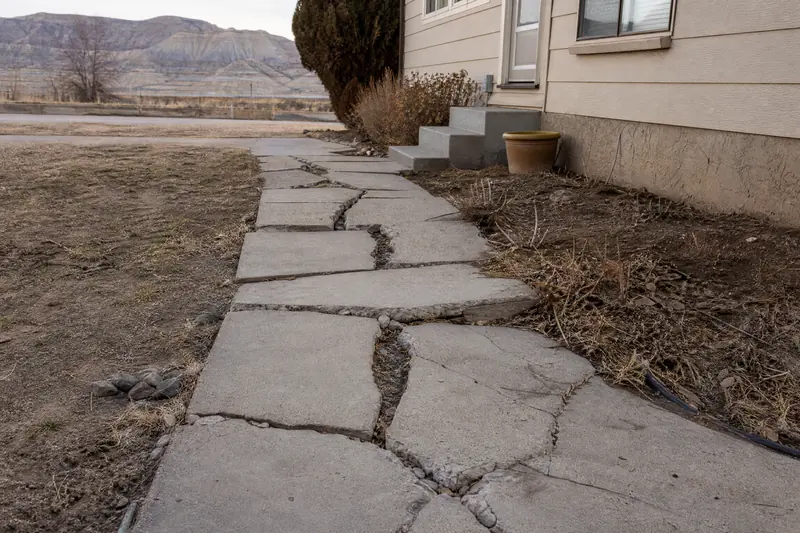
6-1.2 Pipes are where the movement shows
A rigid pipe passing through a wall or slab that moves has nowhere to go. The 1978 guide says water, sewer and gas lines through walls or slabs that may move should be designed to absorb movement. It lists flexible pipe, U-shaped connectors, rubber gaskets and collars as the means, and says sewer vents shouldn't be rigidly attached to slabs or unprotected walls.
You can look at this without touching anything. Find each place a pipe comes through a wall or floor and note whether it looks bent, strained or jammed tight against the opening. Take a dated photo. A second photo a year later will tell you more than a guess.
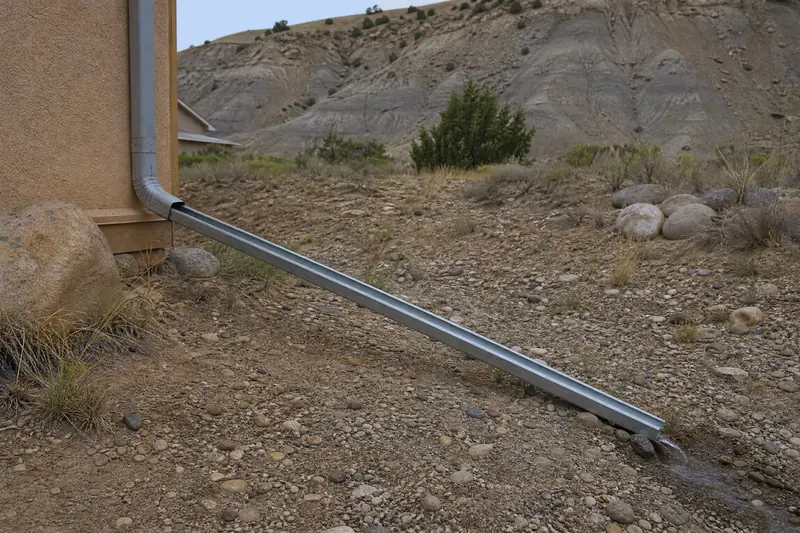
6-1.3 How far back should water and roots stay?
Fig. 6-1 How far back, at least, in feet from the foundation
Colorado Geological Survey SP-11; CSU Extension for 5 and 15 feet.
Five feet for ordinary planting, more for trees, and ten feet for roof runoff. The guide's figures date from 1978, and CSU's current page repeats the five and fifteen.
| What | Keep it | Backed by |
|---|---|---|
| Grass, shrubs, flowers, sprinkler spray | At least 5 feet | Colorado Geological Survey 1978, CSU |
| Trees | At least 15 feet | Colorado Geological Survey 1978, CSU |
| Cottonwood, willow, Russian olive | At least 20 feet | Colorado Geological Survey 1978 |
| Runoff from downspouts and splash blocks | Carried at least 10 feet out | Colorado Geological Survey 1978 |
| Ground surface | Falling away from the house | Colorado Geological Survey 1978, CSU |
On slope, the state's old guide suggests up to 12 inches of fall in 10 feet, and a figure in the same guide shows something different. Current code wording couldn't be confirmed for this manual, so ask your building office before you move dirt (§10-1).
Walk the house after a good rain
- Downspout extensionsIN PLACE
- Water at the foundationNONE STANDING
- Ground beside the wallsFALLING AWAY
- SprinklersSPRAY OFF THE WALLS
- New plantingBACK 5 FEET OR MORE
- Pipe entriesPHOTOGRAPHED, DATED
Ditch or irrigation water deserves the same walk. No source here gives a distance for flood irrigation, so the practical rule is plain: if it reaches the wall, change how it runs. See §5-2 for the line itself.
6-1.4 When the ground has already moved
Sticking doors, new wall cracks or a slab that has stepped can have several causes, and they don't prove swelling. That list is ordinary practical advice, not from a source. Work through it in this order.
- Rule out a leak with the meter or gauge test in §6-2, since a hidden leak can keep the soil wet.
- Fix what you can on the surface: downspouts, grade, sprinklers, planting.
- Have a soil engineer or engineering geologist look at the site, as the survey advises.
- Take any pipe work to a licensed plumber, and ask about permits first (§10-1).
Also asked
Does living in Delta or Montrose mean my lot swells?
No. The old guide says those towns sit on swelling formations, but soil varies by site. Only a soil engineer or engineering geologist should say what yours is. A local office may also hold requirements for your subdivision.
Is the 1978 guide still worth reading?
Its geology is the useful part here. Treat its building details as old and check them against what your building office uses now. The survey's fuller homeowner guide is SP-43, second edition 2007, 76 pages.
How deep do pipes have to be to clear the frost?
This manual has no confirmed frost depth for Mesa, Delta or Montrose counties. Don't take a number from a neighbor or a website. Ask the county building office directly.
Can I plant a cottonwood for shade on the west wall?
Not close in. The state guide puts cottonwood, willow and Russian olive at least 20 feet from the foundation, further than other trees. Measure from the wall before you dig the hole.
Where this comes from
- Colorado Geological Survey, swelling soil hazard page: 3% and 10% figures, pipelines and sewer lines, who should identify the soil.
- Colorado Geological Survey, Special Publication 11, October 1978: formations and towns, pipe details, grade, runoff and planting distances.
- Colorado Geological Survey, swelling soils guide listing: SP-43 edition and length.
- CSU Extension PlantTalk, expansive soils: 5 and 15 foot distances, downspout extensions, grading away.
- Mesa County, subdivision foundation requirements: requirements vary by subdivision, dated 07/29/2022.
Sources checked November 4, 2026.