Test your well water
Well water testing in Colorado falls to the owner, so test at least yearly at a certified lab for total coliform, nitrates, total dissolved solids and pH, and test right away after flooding, nearby digging or a repair.
- Use this when
- You drink from a private well, a test is overdue, or something about the water or the ground around it has changed.
- Done when
- You hold a dated lab report, know what it means and have the next test on your calendar.
- Who
- You and a certified lab, then a well or pump contractor if it needs disinfecting
Written for this manual, last checked against sources November 4, 2026. Who wrote it
2-3.1 Who is responsible for your well water?
You are. EPA says private domestic well quality is "not regulated by the Federal Government under the Safe Drinking Water Act" and that owners answer for safe water. Mesa County Public Health said the same in May 2026 in plainer words: testing is the only way to know if water is safe.
2-3.2 What should you test for, and how often?
Test yearly as a minimum, and test sooner when something changes. EPA names four yearly tests and asks for more often with small children, elderly adults, or anyone pregnant or nursing in the home. CDC adds a spring check of the well for mechanical problems. Mesa County's Regional Lab goes further and recommends testing private wells seasonally for bacteria.
| Test | When | Who says so |
|---|---|---|
| Total coliform, nitrates, total dissolved solids, pH | At least yearly | EPA |
| Bacteria | Seasonally | Mesa County Regional Lab |
| Same tests | Right away after flooding, land disturbance or construction nearby, or any well repair | EPA |
| Same tests | Right away on a change in odor, color or taste | EPA |
| Other local contaminants | Ask the health department which ones | CDC |
| Selenium | Your choice, by lab order, see §2-4 | This manual |
2-3.3 Where do you send a sample?
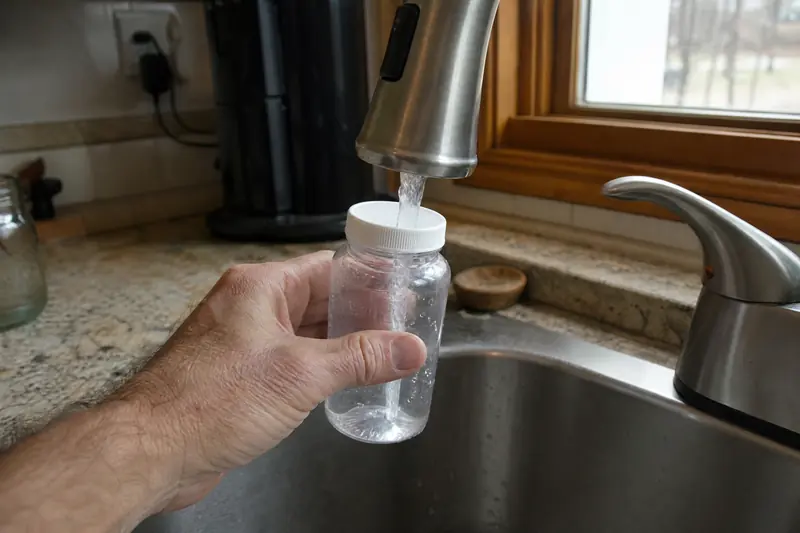
Use a certified lab, as both EPA and CDC say. On the Slope, Mesa County's Regional Lab offers a coliform present/absent test with E. coli for wells and cisterns, is certified by the state health department, and gives private well owners guidance and shock chlorination support.
We couldn't open the state health department's labs list, or the Delta County and Montrose County health pages, when this was last checked in November 2026. If you live in those counties, call the county health office and ask which certified lab it points owners to, and how to collect the sample so it counts.
- Ask the lab for its bottle and its instructions before you collect anything.
- Follow its timing for getting the sample back.
- File the report with the date on your house card (§1-1).
- Put the next test on the calendar now.
2-3.4 What do the bacteria results mean?
A positive result tells you germs may have a way in, and the two names don't mean the same thing. EPA says total coliform isn't itself a health threat but shows whether other harmful bacteria may be present, and that E. coli indicates human or animal waste. CDC says a high coliform count suggests harmful germs may be present and a positive E. coli suggests feces has entered the water. Either way, CDC points you to bottled or other safe water and the health department.
Positive coliform or E. coli
- Drinking and cooking waterSAFE SOURCE ONLY
- Health departmentCALL, READ THEM THE REPORT
- Well pit, if you have oneSTAY OUT
- Well or pump contractorBOOK DISINFECTING
- RetestAS THE SCHEDULE BELOW
2-3.5 How does a well get disinfected?
By a contractor, as the default. CDC says, of wells after an emergency, that they "should be disinfected by a well or pump contractor, due to safety concerns." After a flood at the wellhead, EPA says to stay away from the pump while it's flooded because of shock risk, not to drink or wash with the water, and to have a well or pump contractor clean and disinfect before restart.
Outside a flood, Mesa County publishes a shock chlorination procedure as local information. The copy reviewed here was created in 2019, and the lab's page links a newer 2026 version, so ask the lab for the current one. Its cautions are worth knowing even if you hire the job: never mix chlorine with acids or ammonia, don't flush chlorinated water into a septic system, avoid draining it onto lawns, and don't chlorinate carbon filters. Where sources differ on hold time, go with CDC's at least 12 hours.
After chlorinating, follow CDC's retest schedule. Test 7 to 10 days after all chlorine is flushed, again at 2 to 4 weeks and at 3 to 4 months, then at least twice a year. Until a test confirms the water is safe, use another source or boil it: CDC gives a rolling boil for 1 minute, and EPA says three minutes above 5,000 feet, which takes in most Slope towns.
Moving picture for §2-3
How to Test Your Well Water, posted by mnhealth. From Minnesota's health department, with that state's schedule and labs. It doesn't cover selenium. The still picture sits on this site; nothing comes from YouTube until you press Play.
Linked from this manual
- Hardness, iron and pH field kit. A field kit for hardness, iron and pH. It doesn't replace a certified lab for coliform or selenium. This manual’s team is connected with Quality Water Treatment.
Also asked
Is a yearly test enough if the water tastes fine?
Taste won't tell you. EPA and CDC set yearly as the minimum, and Mesa County's lab advises seasonal bacteria testing, so yearly is the floor and more is reasonable.
My well was under floodwater. Can I boil the water and carry on?
Not as a plan. CSU Extension says not to use it for drinking, cooking or bathing until the well is purged and disinfected, if floodwater contaminated the wellhead. Get a contractor and retest first.
Does a home test kit count?
It can show hardness, iron and pH for your own information. Bacteria results that you act on come from a certified lab.
Can I test cistern water at the same lab?
Mesa County's Regional Lab lists its coliform test for cisterns as well as wells. Keeping a cistern clean is in §3-3.
Where this comes from
- EPA, emergency disinfection of drinking water: boiling time above 5,000 feet.
- EPA, private drinking water wells: private wells fall outside the federal act.
- EPA, protect your home's water: yearly tests, immediate triggers, certified labs, flooded wellhead.
- CDC, guidelines for testing well water: yearly test, spring check, what coliform and E. coli suggest, safe water and the health department.
- CDC, disinfecting wells after an emergency: contractor rule, well pit warning, 12-hour hold, retest schedule, fuel smell.
- EPA, national primary drinking water regulations: what total coliform and E. coli indicate.
- Mesa County Regional Lab: the coliform test, certification, seasonal advice.
- Mesa County Public Health, May 5, 2026: testing as the only way to know, lab support for owners.
- Mesa County shock chlorination procedure, created 2019: local procedure and its cautions.
- CSU Extension, emergency water supplies: flooded wellhead use limits.
Sources checked November 4, 2026.