Contents Chapter 3. Cisterns and hauled water
Hauled water and who may deliver it
Hauled water in Colorado comes by vehicle tank, and some haulers fall under state rules for public water systems, so ask any hauler where the water is loaded and how the tank is kept.
- Use this when
- You fill a cistern by truck, are choosing a hauler, or want to haul water yourself from a fill station.
- Done when
- You have answers from your hauler on your house card, or a fill station account and a clean, drinking-water-only tank.
- Who
- You, and your hauler or the fill station's operator
Written for this manual, last checked against sources November 4, 2026. Who wrote it
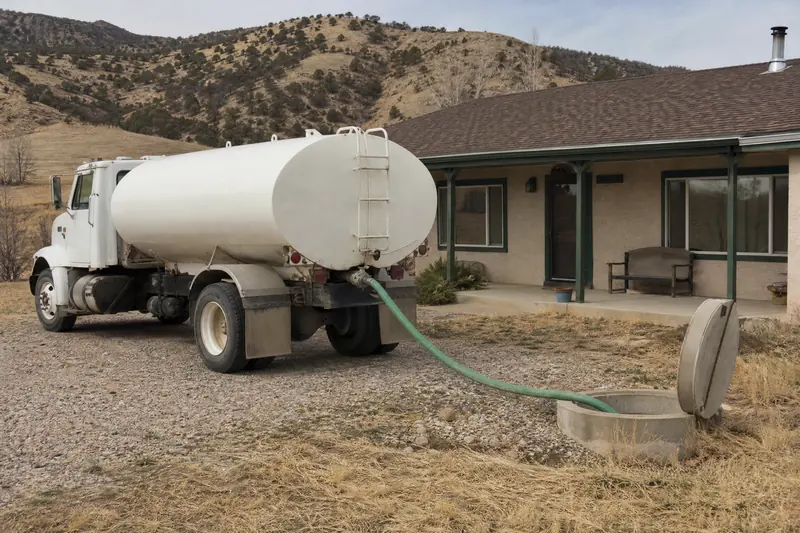
3-2.1 Does the state regulate every water hauler?
Don't assume so. This manual can tell you what the rule says and not how it lands on every small truck. Colorado's Regulation 11, as published, defines a public water system as one with at least 15 service connections or regularly serving an average of 25 or more people daily at least 60 days a year. It defines a "public water system that hauls water" as one delivering finished water by vehicle through a non-piped conveyance such as a vehicle-mounted tank.
Regulation 11.41 says such a hauler must run under a Department-approved operational plan, its own or the pre-approved plan in the Department's handbook. It must also check residual disinfectant at least once on each delivery day from each tank. Failure is a treatment technique violation.
Those rules attach to public water systems. How the state treats a small hauler serving a few homes stayed unconfirmed, because we couldn't open the state health department's pages when this was last checked in November 2026. Ask it directly, and ask your hauler which category it's in.
3-2.2 What should you ask a water hauler?
Ask where the water comes from and how the tank is kept, then keep the answers. These questions are this manual's own, built from the rule and CDC's tanker guidance below.
- Are you operating under a state-approved plan?
- Where do you load?
- Is this tank used only for drinking water?
- Do you check chlorine residual on delivery days, and can I see the log?
- Can you fill my tank without anyone entering it?
Before the truck arrives
- Tank levelCHECK FROM OUTSIDE
- Fill portCLEAR, ACCESS OPEN
- Drive and turnaroundPASSABLE, SNOW CLEARED
- HatchCLOSED
- VentSCREENED, UNBLOCKED
- Your hauler's answersON THE HOUSE CARD
- After fillingHATCH SHUT, DATE LOGGED
3-2.3 How clean should a hauling tank be?
The only numbers this manual can give come from guidance written for healthcare facilities, so treat them as a reference and not a rule for your hauler. CDC's emergency water supply guide calls for inside surfaces of a tanker at a minimum of 50 mg/L chlorine for at least 30 minutes, about 1 gallon of 5.25-6% bleach per 1,000 gallons. It says stored water should stay at 0.5-2.0 mg/L free chlorine.
A hauler who can tell you how the tank gets cleaned, and can show a residual reading, is giving you what you need to know. Bacteria testing of your own stored water goes through a lab, as in §2-3.
3-2.4 Where can you fill a tank yourself?
A few water providers sell bulk water, and the terms differ. Ask whether the water is meant for drinking before you put it in a house tank, because not every page says.
| Provider | Where | What the page says | Still to check |
|---|---|---|---|
| Clifton Water District | Two pre-pay stations in Whitewater, 971 Coffman Road and 3000 Reeder Mesa Road | 2-inch connections above 100 PSI; online application; allow at least 4 business hours for setup; RV filling not recommended | Page doesn't state potability |
| Tri-County Water | Five dispenser stations in the Montrose and Delta area | $5.00 per 1,000 gallons on an undated page | Current price; the location map couldn't be opened |
| Grand Junction | Not confirmed | We couldn't open the city's pages | Ask the city directly |
No other fill stations in Delta or Montrose turned up. Water providers change terms, so call ahead using the number on the provider's own site.
Also asked
Is water from a hauler automatically safe?
This manual can't say so. The rules described here attach to public water systems that haul, so ask about the plan, the loading point and the residual check, and test stored water at a lab if you drink it.
Why does the chlorine level matter on delivery?
Regulation 11.41 has public water systems that haul check residual disinfectant on each delivery day. CDC's guide gives 0.5-2.0 mg/L free chlorine for stored water, in a healthcare setting.
Can I haul my own drinking water from a fill station?
You can use a station if the provider accepts you, but check potability first, since Clifton's page doesn't state it. Use a tank that has only ever held drinking water.
How much does hauled water cost?
This manual has no current delivered price. The one bulk figure it found is Tri-County's undated $5.00 per 1,000 gallons at the station, so confirm before relying on it.
Where this comes from
- Colorado Regulation 11.3, definitions: public water system and hauling (published copy of the regulation).
- Colorado Regulation 11.41, haulers: operational plan and residual checks (published copy of the regulation).
- CDC, emergency water supply planning guide, 2019: tanker disinfection and stored water chlorine, pages 25 and 26, written for healthcare facilities.
- Clifton Water District, fill station: locations, connections and setup.
- Tri-County Water: dispenser stations and undated price.
Sources checked November 4, 2026.