Burst pipe or water running
After a burst pipe, stay clear of water near electrics, close the main shutoff, then open the faucets on that line to drain it.
If a line has split
- Water near outlets, cords or panelSTAY OUT OF IT
- Light switches, if standing in waterDON'T TOUCH
- Main shutoffCLOSED
- Still running, on a well or cisternPUMP BREAKER OFF, IF DRY
- Faucets on that lineOPEN
- Water heaterLEAVE ALONE, CALL IF LEAKING
- PlumberCALL
- Use this when
- Water is spraying, running or pooling from a pipe, fitting or supply line.
- Done when
- The water has stopped, the area is safe, and a plumber has the repair.
- Who
- You, then a licensed plumber
Written for this manual, last checked against sources November 4, 2026. Who wrote it
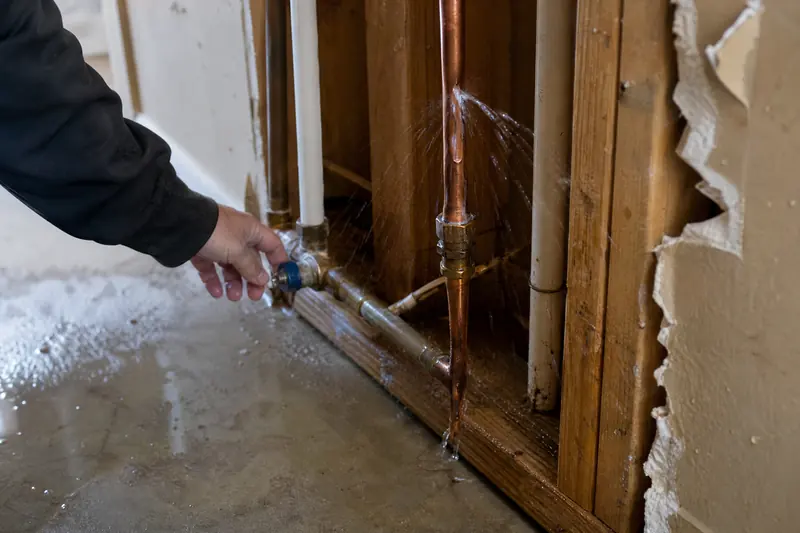
E-3.1 Stop the water first, if you can reach it dry
Closing the main is the one move that matters, and the Insurance Institute for Business & Home Safety puts it first: shut off the water supply, then call a plumber. Where the valve is, and how a well or cistern house differs, is in §1-2. Utah State University Extension says to teach adults and older children where the main is and how to work it. Do that before you need it.
Open the faucets on that line once the main is closed. That lets out what's left in the pipe.
E-3.2 Electrics near the water
Illinois Extension says to always be careful of the potential for electric shock in and around standing water. A propane industry brochure adds: never turn on a switch or inspect appliances while standing in water.
If the only way to the panel or the valve is through water, don't go. Leave the house and call your electric utility, using the number on your bill. Tell the plumber or the utility that the valve wasn't reached. Any gas smell changes the job: go to §E-1.
E-3.3 If water keeps coming
Water still running after the main is closed usually means the break is on the supply side of the valve.
- Well or cistern: switch off the pump breaker, if you can reach the panel dry. The pump can run on and on when a line has broken.
- Town water: call your water provider, using the number on your bill. Don't open or lean into a meter pit. Those pits are for trained crews only.
E-3.4 After it stops
Burst frozen pipes are a common cause of winter water damage, so if the weather's cold, check for other frozen runs with §E-4 before you open the main again.
A failed flexible line under a sink or at a toilet is often the small version of this. The stop valve under that fixture may be enough, §7-1. The line can be replaced once the water's off. Homeowner plumbing rules are in §10-2.
Moving picture for §E-3
How to find your water shut off valve, posted by Texas Department of Insurance (TDI). From a Texas agency, and it shows a shallow yard box. Never climb into a meter pit here. Well and cistern houses shut off at the tank or pump (§1-2). The still picture sits on this site; nothing comes from YouTube until you press Play.
Linked from this manual
- Braided supply lines. Replacement lines for a failed supply line, once the water's off. This manual’s team is connected with PlumbingSupplyAndMore.
Where this comes from
- IBHS, after a winter event: shut off the water first, call a plumber.
- IBHS, winter ready: burst pipes as a common cause of winter damage.
- Utah State University Extension, frozen pipes: teach the household the main shutoff.
- Illinois Extension, water pipes: shock risk around standing water.
- Propane Education & Research Council brochure, republished by Iowa DNR: switches and appliances while standing in water. This document also has a tank-valve step that this manual leaves out on purpose.
- University of Nebraska Extension G2153, 2012: a pump that keeps running may have a broken line.
Sources checked November 4, 2026.