Contents Chapter 9. Swamp coolers
Winterizing a swamp cooler
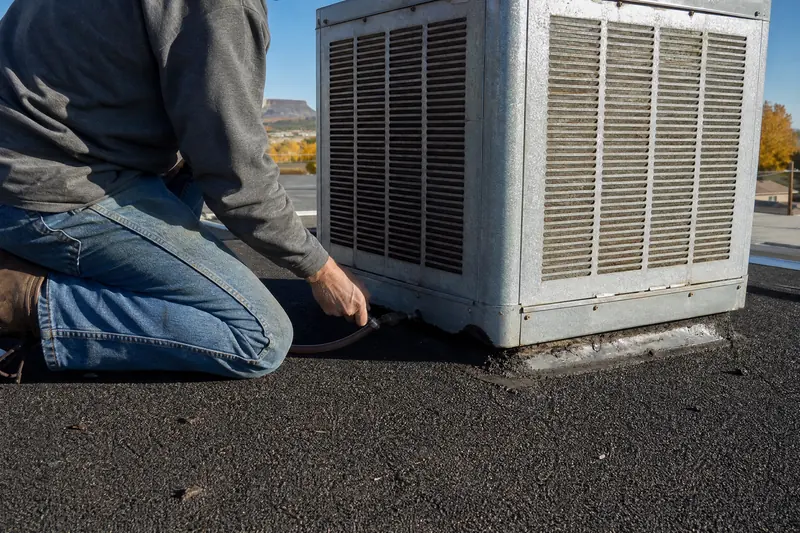
To winterize a swamp cooler, turn off the power at the breaker or switch before climbing, then drain and clean the tray, disconnect and clear the water line, and cover the unit.
- Use this when
- Cooling season is over and the first freeze is coming, or a freeze warning caught you with the cooler still connected.
- Done when
- Power is off and labeled, the line is disconnected and empty, the tray is dry, and the cover is tied down.
- Who
- You, if you are sure on a ladder and a roof; otherwise someone you hire
Written for this manual, last checked against sources November 4, 2026. Who wrote it
9-2.1 Which steps come from a source?
Only part of this. The cleaning and water-line steps come from the University of Arizona Extension, an Arizona page written for Arizona's winters. Everything about power, and some of the small details, is this manual's own rule or ordinary practice. No source opened for this section gives a power step, and that doesn't make it optional.
| Step | Basis |
|---|---|
| Power off before climbing, off until spring | This manual's safety rule |
| Dissolve mineral with vinegar | Arizona Extension |
| Drain, scrape, clear trough holes, dry | Arizona Extension |
| Check for cracks, seal against rust | Arizona Extension |
| Disconnect the water line and blow it out | Arizona Extension |
| Cover the unit | Arizona Extension |
| Close the feed valve first, close indoor grille | Ordinary practice |
9-2.2 What order do you do it in?
Turn the power off from the ground, and leave it off. Every step below happens with the unit dead, and it stays dead until §9-1 next spring.
From the ground, first
- Cooler breaker or switchOFF
- Wall controlSET TO OFF
- Label on the breaker"COOLER, OFF FOR WINTER"
- Feed valve for the cooler lineCLOSED
- HelperON THE GROUND
- Go up with the power off and remove the panels.
- Disconnect the water line at the cooler.
- Drain the tray, then use vinegar to dissolve the mineral. The page gives no amount or time, so use enough to loosen it and wait until it softens.
- Scrape the tray, clear the trough holes and let everything dry.
- Check for cracks and seal against rust. Note any pads to replace in spring.
- Blow out the water line, which the page tells you to do without giving a pressure. Wear eye protection, go gently, and if you have no safe way to do it, have someone do it for you.
- Refit the panels and cover the unit, which protects it and keeps cold air out. Tie the cover down so wind can't take it.
- Come down and put the ladder away. Close the indoor grille if there is one. The breaker stays off.
9-2.3 How early should you do it?
Beat the first freeze: finish by the end of September, with the fall freeze check. The Colorado Climate Center's 2024 post gives these first-freeze facts.
| Measure | Date |
|---|---|
| Palisade average, latest in the state | October 26 |
| Other Grand Junction stations, average | Late October |
| Grand Valley, 10th percentile | Mid-October |
| Earliest in Palisade since 1991 | October 4, 2016 |
The same post says the average first freeze has moved over a week earlier since 1980. It doesn't give dates for Delta, Montrose, Paonia or Cedaredge in what this manual could confirm, so ask a neighbor who keeps track or go by your own records. Higher ground is where you'd want to act sooner. A water line that stays connected is the part that can freeze and split.
9-2.4 What if the line is already frozen?
Treat it as a frozen pipe, with the cooler left off. §E-4 has the thawing rules: no flame, no torch and no boiling water. A roof is a poor place for a hair dryer and a cord, so as ordinary sense, close the feed valve and hire out a line you can't reach from solid ground. If the line has split and water is running, go to §E-3 and close the shutoff before anything else. Then look for ceiling stains under the cooler, which Clifton Water District's self-audit lists among things to check.
Do this job on the same weekend as the fall freeze check, §7-1.
Moving picture for §9-2
10 Winterizing Tips, posted by Phoenix Manufacturing. From a cooler maker that mentions its own winter panel. Power off first, and your own cooler's manual comes before this. The still picture sits on this site; nothing comes from YouTube until you press Play.
Also asked
Do I have to disconnect the line, or is closing the valve enough?
The Arizona page says to disconnect and blow it out. Closing the feed valve alone leaves water in the line beyond it, and that water can freeze. If the line runs up an outside wall or over a roof, it deserves the full treatment.
Should the power really stay off all winter?
This manual says yes. A dry pump and a covered cooler have no reason to run, and a bumped wall control can start a fan inside a tied-down cover. It also means the unit is already dead when you go up in spring.
Do I need a special cover?
The Arizona page only says to cover it, to protect the unit and keep cold air out. Fit it snug and tie it well, since wind on an open roof will find a loose one.
I missed the first freeze. Is it too late?
No. Wait for a dry, frost-free day, follow the same order, and then check the line and fittings for splits. Look for leaks when water goes back on in spring, using §9-1.
Where this comes from
- University of Arizona Extension, Cochise County Water Wise, water-saving tips (Arizona): vinegar, draining, scraping, trough holes, cracks, rust, disconnecting and blowing out the line, the cover.
- NIOSH, ladder safety, reviewed March 1, 2024: ladder deaths and injuries, ladder angle.
- Colorado Climate Center, first fall freezes, 2024: first freeze dates and the trend since 1980.
- Clifton Water District, indoor leak self-audit: cooler leak checks.
Sources checked November 4, 2026.