Living with a propane tank
Propane tank safety at home means calling before the gauge drops below 20 percent, keeping the tank area clear, leaving every valve to your supplier, and leaving the house at any gas smell.
- Use this when
- A propane tank on your property feeds your heat, water heater, range or anything else.
- Done when
- The supplier's number is on your house card, deliveries are planned, the tank area is clear, and everyone at home knows §E-1.
- Who
- You for the gauge, the snow and the phone call; your supplier or a qualified technician for everything else
Written for this manual, last checked against sources November 4, 2026. Who wrote it
Most propane advice in print comes from the industry's own group, the Propane Education & Research Council (PERC). The brochures linked here are older print pieces republished by state agencies, and one carries a 2006 copyright. If you follow the links you will see valve steps this manual leaves out on purpose. Here, people get out first and nobody touches a valve.
8-1.1 How do you read the tank gauge?
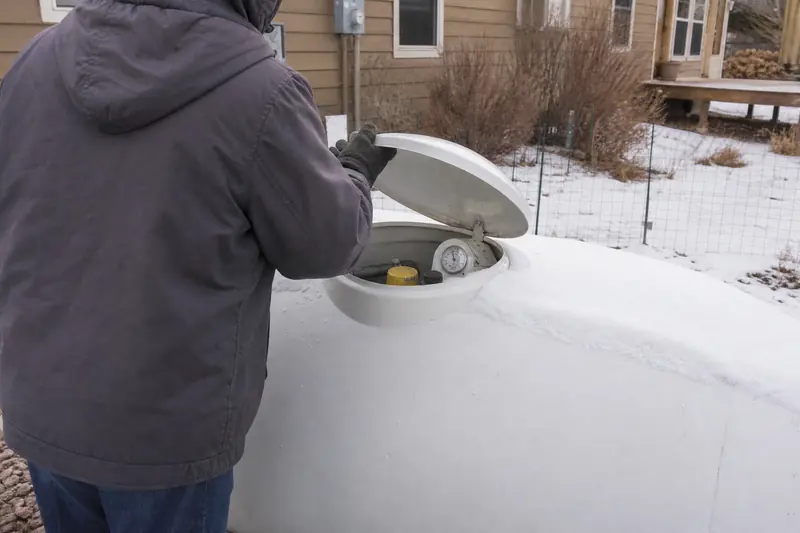
The gauge shows the percent of propane in the tank. Call your supplier when it falls toward 20 percent, and don't let it sit below that. The same brochure advises a regular delivery schedule, which takes the watching off your hands.
As ordinary practice, read the gauge on a set day each week through the heating season and write the number on a calendar. If the gauge sits under a lid and you aren't sure what you are looking at, ask the driver to show you at the next delivery. Look only. Everything else under that lid belongs to the supplier.
A tank won't read full after a delivery. Suppliers leave room for the propane to expand, and the limits published for different containers don't give one number that this manual can state for home tanks. Ask yours how full they fill. While you have them on the line, ask who owns the tank and what your contract says about it, and put the number on your house card, §1-1.
8-1.2 What happens if the tank runs empty?
Running out is a safety event, and the fix is a phone call. PERC says it can create fire or explosion hazards: an open appliance valve or line can leak when the system is recharged, air and moisture in an empty tank cause rust that weakens the odor, and pilot lights go out.
If the tank is empty or the pilots are out
- Any gas smellGO TO §E-1 NOW
- Tank valves and regulatorDON'T TOUCH
- Appliance controls and pilotsLEAVE ALONE
- Your supplierCALL, SAY IT RAN OUT
- Gas oven or range for heatNEVER
- Restarting the gasSUPPLIER OR TECHNICIAN
PERC says that "in many states" a retailer or qualified technician must run a leak check before the gas goes back on. This manual couldn't confirm Colorado's own wording, so ask your supplier what they do.
Pilots can go out early. A Colorado fire district warns that pilots may go out while gas is still on as a tank nears empty. PERC strongly recommends a qualified technician light any pilot that has gone out, and says repeated outages may signal a problem you shouldn't try to fix.
If the pipes are at risk while you wait, go to §7-1 for what protects them and §E-4 if one has already frozen.
8-1.3 Snow, brush and the driver's path
Heavy snow and ice on the equipment matter, since PERC says they can cause damage leading to a leak. Carefully clear loose snow with a broom, not a shovel. Touch nothing, and call your supplier if anything looks wrong or is frozen in place.
- Keep a walkway and the tank area clear for the delivery driver.
- Keep the area within 10 feet of the tank free of leaves, brush, rags and other things that burn.
- Keep drifts back from outside appliance vents. CPSC said in February 2026 to clear snow from them.
- If you see nests, snow or ice in a vent pipe, that is a technician's call. See §E-2 for what a blocked vent can lead to.
8-1.4 Why can you miss the smell?
Your nose is a good alarm with some known faults. Propane is odorless until odorant is added, and people describe the added smell as rotten eggs, skunk spray or a dead animal.
That smell can weaken. NIOSH says odorant can fade through soil, concrete, drywall, wood, and new pipes or tanks, and it names odor fade as a key factor in a 2019 propane explosion that killed one firefighter and hospitalized six. PERC adds air, water or rust in a tank as causes. People also miss it because of colds, allergies, smoking, cooking odors, age, odor fatigue or being asleep, and gas can collect in a basement or attic out of range.
So treat even a faint odor as the real thing. Once responders clear the house, have your retailer or a qualified technician check the whole system before anyone uses an appliance.
| Job | Who |
|---|---|
| Reading the gauge, calling for delivery | You |
| Loose snow, brush and the driver's path | You, with a broom |
| Any valve, regulator or appliance part | Supplier or technician |
| Lighting a pilot that went out | Technician |
| Leak check after running out | Retailer or technician |
| Blocked vent pipe | Technician |
Also asked
Is a propane detector worth having?
PERC says to consider one or more UL-listed units, placed and maintained as the maker says, and a Colorado fire district recommends them alongside smoke and CO alarms. Treat one as an added layer. Any smell still means leave, even if the detector stays silent.
Can I keep a spare grill cylinder in the garage?
No. PERC says never store a cylinder indoors or in a garage, shed or basement. Grills, outdoor heaters and generators also stay out of the house.
Can the oven keep the house warm until the truck comes?
No. PERC and Ready.gov both say never to heat a home with a gas range or oven. Carbon monoxide is the danger, and §E-2 covers what to do if an alarm sounds.
Can a generator run close to the house during an outage?
Keep it outdoors and at least 20 feet from the house, and at least that far from doors, windows and vents. Never run one in a garage or carport.
Where this comes from
- PERC, Propane Safety brochure, on the Iowa DNR site: smell description, no repairs to valves or appliances, cylinder storage, whole-system check, no oven heating. This document also has a tank-valve step that this manual leaves out on purpose.
- PERC, general propane manual, on the Iowa HHS site: gauge, running out, leak check, pilots, snow, vents, odor fade, detectors. This document also has a tank-valve step that this manual leaves out on purpose.
- PERC, extreme-heat brochure, on the North Carolina agriculture site: the 10-foot clear area.
- Crystal Lakes Fire, a Colorado fire district, propane safety page: faint odor, near-empty pilots, detectors. This document also has a tank-valve step that this manual leaves out on purpose.
- NIOSH, odor fade publication: odorant, odor fade, the 2019 explosion.
- CPSC, February 19, 2026 release: clearing snow from outside vents, generator distance.
- CDC, generator carbon monoxide toolkit: generator distance from doors, windows and vents.
- CDC, generator flyer: no generators indoors, in garages or carports.
- Ready.gov, winter weather: no heating with a range or oven.
Sources checked November 4, 2026.