Contents Chapter 1. Know your house
Find and test your shutoffs
How to shut off water to a house: find the main valve where the line enters, know the pump breaker on a well or cistern, and test both once a year.
- Use this when
- You don't know where your valves are, or nobody has turned them in a year.
- Done when
- Each shutoff is tagged, tested, on your house card, and known to everyone at home.
- Who
- You, then a licensed plumber for a valve that sticks or leaks
Written for this manual, last checked against sources November 4, 2026. Who wrote it
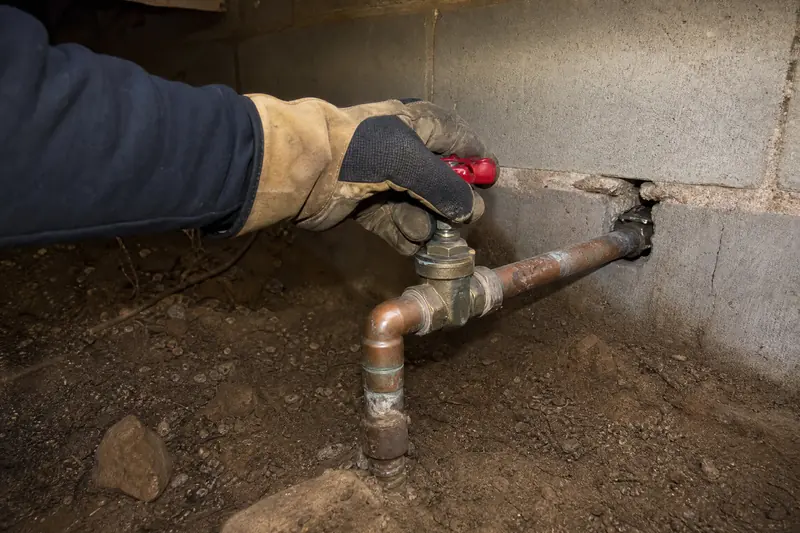
1-2.1 Where is the main shutoff?
The main shutoff is usually where the water line first enters the house: a basement wall, a crawl-space hatch, a utility closet or a garage. That's practical advice, not a rule, and older houses vary. Trace the pipe back from the water heater or the softener if you're stuck. Once you've found it, tag it and put its location on the house card, §1-1.
Where you look depends on what feeds the house.
| Source | Stops the water | Stops the pump | Leave alone |
|---|---|---|---|
| Town water | Main valve inside the house | None | Meter pit and curb valve |
| Well | Valve on the line leaving the pressure tank | Pump breaker | Pressure switch, tank air valve |
| Cistern | Valve on the line leaving the cistern pump | Cistern pump breaker | Hatch, tank interior |
| Ditch irrigation | Valves on the separate irrigation line | Irrigation pump breaker | Headgate and company gates |
Utah State University Extension says to teach adults and older children where the main is and how to use it. The Insurance Institute for Business & Home Safety puts shutting off the water first when a pipe bursts, which is why this section sits so near the front of the manual.
1-2.2 The pump breaker on a well or cistern
A closed valve stops water reaching the house, but the pump is on a separate electric circuit, and that circuit is what you check first when the water stops. University of Nebraska Extension's order for a dead well starts with the breaker or fuse, then the gauge at the tank. Label yours now, while nothing is wrong.
Stop at the breaker. The pressure switch beside the tank is connected to electric power and could cause serious injury, so leave its cover on and don't adjust it. Details are in §2-2.
1-2.3 Which water heater valve is yours?
Only the cold-water valve on the pipe going into the heater. That valve stops water reaching the tank and lets you isolate a leak there. The heater's other parts are not part of this drill.
The relief valve must not be removed or plugged, according to one maker's manual. If it's dripping, that's a sign for the plumber, §8-3. Gas lines, gas valves and burner parts are for a qualified technician, and this manual gives no steps for them. If you smell gas, go to §E-1.
1-2.4 How do you test a shutoff?
Test once a year, on a day when you have time to deal with a stuck valve. Fall works well, before the freeze check in §7-1. This schedule is this manual's advice. No source sets one.
Yearly shutoff test
- All faucets and appliances using waterOFF
- Main shutoffCLOSE SLOWLY, BY HAND
- Nearest low faucetOPEN, FLOW MUST STOP
- Still running after a few minutesVALVE FAILED, CALL PLUMBER
- Main shutoffREOPEN SLOWLY
- Valve stem and jointsCHECK FOR DRIPS
- FaucetsRUN TO CLEAR AIR
- Pump breaker labelCONFIRM IT MATCHES
- House cardDATE IT
Two kinds of valve are common. A ball valve has a lever that turns a quarter turn, and the lever lies across the pipe when closed. A gate valve has a round handle that takes several turns. A ball valve is easier to read at a glance.
Moving picture for §1-2
How to Locate Your Main Water Shut Off, posted by Western Virginia Water Authority. From a Virginia water authority, with a town-water layout. Well and cistern houses differ. The still picture sits on this site; nothing comes from YouTube until you press Play.
Linked from this manual
- Ball valves. Replacement shutoff valves. On the main, that's a plumber's install. This manual’s team is connected with PlumbingSupplyAndMore.
Also asked
Can I replace the main shutoff myself?
As published in Colorado's statutes, no license is needed for plumbing on your own residence, with exclusions for rentals and homes being sold by a builder or remodeler. Plumbing work generally needs a permit and inspection. This manual still treats the main as a plumber's job, because you can't stop the water on the supply side. See §10-2.
Should I shut off the water when I leave for a week in winter?
Illinois Extension gives two safe plans: keep the heat at 55 degrees or above and have someone check daily, or drain and shut off the water. Closing the main without draining is a half-measure, since water stays in the pipes. See §7-3.
Does this page cover the gas shutoff?
No. This manual doesn't send homeowners to any gas valve or tank valve. If you smell gas, everyone gets out and makes the calls from outside, §E-1. Ask your supplier or gas utility what they want done about gas equipment on your property.
Will closing the main stop my sprinklers?
It depends on the source. A system fed from house water usually stops with the main, while a ditch-fed line runs separately, with its own valves and pump. Trace yours, write it on the card, and read §5-1 if the two systems touch anywhere.
Where this comes from
- Utah State University Extension, frozen pipes: teach the household the main shutoff.
- IBHS, after a winter event: shut off water first.
- University of Nebraska Extension G2153, 2012: pump breaker, gauge, pressure switch warning.
- A.O. Smith BT-65 instruction manual: relief valve, for that model.
- Illinois Extension, water pipes: away-from-home options.
- C.R.S. 12-155-118 (published copy of the statute): own-property plumbing exemption.
- C.R.S. 12-155-120 (published copy of the statute): permits and inspection.
Sources checked November 4, 2026.