Contents Chapter 3. Cisterns and hauled water
How a cistern system works
A cistern water system in Colorado stores drinking water in a large tank and sends it to the house under pressure, and state law limits who may install a tank between a wellhead and the pressure tank.
- Use this when
- Your house runs on a cistern, you are buying one that does, or you are thinking of adding a tank or catching roof water.
- Done when
- You can trace the water from tank to tap, know who installed each part, and know which rule applies to anything you want to add.
- Who
- You for looking, then a licensed pump installer and your county building office
Written for this manual, last checked against sources November 4, 2026. Who wrote it
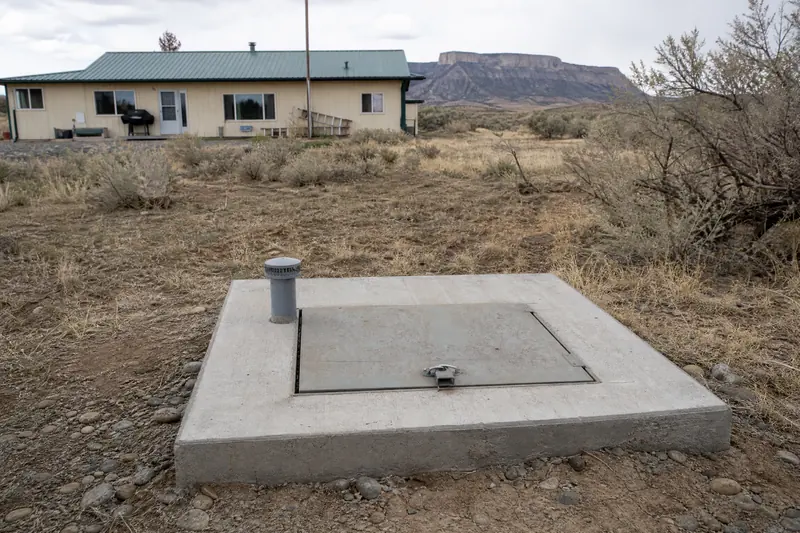
3-1.1 What is a cistern, and how does the water reach the tap?
A cistern is a big drinking-water container with a pump to move the water. CDC describes one as a large container on a roof, underground or beside a home. An untreated catchment cistern holds rain, groundwater, spring or surface water, and a tank may also be filled by a delivery truck (§3-2).
A typical layout runs like this, as practical description and not a code rule. Layouts vary, so walk your own and sketch it for your house card (§1-1).
- Water comes in through a fill port or a line from a well.
- The tank holds it, with a hatch and a vent.
- A pump draws from the tank.
- A pressure tank and switch keep the house lines under pressure (§2-2).
- Any filters come next, then the house main shutoff (§1-2).
3-1.2 Who may install a cistern in Colorado?
Part of that answer is set by statute. As published in Colorado's statutes, only a licensed pump installation contractor may install a cistern or storage tank between the wellhead and the pressure tank, or downstream of the wellhead if there is no pressure tank. That rule speaks to a tank tied to a well. A separate section exempts "private pump installers" from license requirements, and the two don't sit neatly together, so this manual doesn't tell owners they may do this work. Ask the Division of Water Resources or a licensed installer about your case.
Local rules are harder to pin down. This manual found no official capacity rule or potable-tank specification, and no Mesa County cistern requirement. We couldn't open the Delta County or Montrose County pages when this was last checked in November 2026, so ask each county's building and health offices directly before you buy a tank.
3-1.3 Does a cistern on a town line need backflow protection?
It can, and the risk is real. A Colorado drinking-water program blog, which doesn't name its operator but points to the state health department, says private cisterns supplementing a public supply can pose a backflow risk. It describes a September 2018 Delta County case where a distribution system was contaminated by an "inadequately controlled" cistern with a single non-testable check valve.
The same post says a cistern built to the 2018 Colorado Plumbing Code "is not considered a cross-connection." Otherwise it needs an approved assembly, either a reduced-pressure zone assembly or a testable double check, or an air gap, and the supplier must control it within 120 days of discovery. If you have both a tap and a tank, ask your water supplier how it wants them separated.
Tracing your own system
- Fill port and hatchCLOSED, CLEAR OF DEBRIS
- VentSCREENED, NOT BLOCKED
- Your head and armsOUTSIDE THE TANK
- Pump and pressure tankFIND, DON'T ADJUST
- Filters, if anyNOTE THE CARTRIDGE TYPE
- Tie to a town lineASK YOUR SUPPLIER
- Installer's nameWRITE ON HOUSE CARD
3-1.4 Can you catch rainwater in Colorado?
Yes, within narrow limits and not for drinking. Colorado has two routes, and CSU Extension says plainly: "Untreated rainwater collected from roofs is not safe to drink." It also says rain-barrel use is not a water right.
| Rain barrels | Rooftop collection permit | |
|---|---|---|
| Who | Single-family home, or a multi-family building of four or fewer units | Exempt-well owners who apply to the state |
| Size | At most two barrels, 110 gallons or less combined | No barrel size limit |
| Roof | Your building | Primary residence only |
| Use | Outdoors on the same property, never drinking or indoors | Only the uses your well permit allows |
| Other limit | The state engineer may curtail use | A 2009 state flyer adds no municipal or district supply in the area, so confirm |
Linked from this manual
- Water filters and housings. Filter housings and cartridges for the line after the tank. What you need depends on your lab results (§2-3), and a filter doesn't replace testing. This manual’s team is connected with PlumbingSupplyAndMore.
Also asked
Can a cistern be connected to my town water for backup?
Not casually. The state program's blog says an uncontrolled cistern on a public supply is a backflow risk, and your supplier can require an approved assembly or an air gap. Ask it before any plumbing changes.
What size cistern do I need?
This manual found no official capacity rule, so no number is given here. Your county offices, your installer and your household's own use are the places to work it out.
Can I fill my cistern from a rain barrel?
Colorado's barrel statute says outdoor use on the same property only, never drinking or indoor use, so no. The rooftop permit route has its own limits, set out in the table above.
Do I need to tell anyone I have a cistern?
If you also have a public water connection, tell your supplier, since it has to control cross-connections. Delta and Montrose county rules are unconfirmed, so ask those offices too.
Where this comes from
- CDC, cistern safety and disasters: what a cistern is, catchment types.
- C.R.S. 37-91-109, construction and licensing: who may install a tank before the pressure tank (published copy of the statute).
- C.R.S. 37-91-106, exemptions: private pump installers (published copy of the statute).
- Colorado drinking-water program blog, 2020: backflow risk, the 2018 Delta County case, assemblies, 120 days.
- C.R.S. 37-96.5-103, rain barrels: barrel limits and uses (published copy of the statute).
- CSU Extension, rainwater collection in Colorado: not safe to drink, not a water right, rooftop permit.
- Division of Water Resources flyer, 2009, hosted by CSU: the added rooftop permit condition.
- NIOSH publication 87-113, confined spaces: storage tanks as confined spaces.
Sources checked November 4, 2026.